Paver Patio Cost: Bluestone vs Pavers for a New England Backyard
· By Sidney Mota Machado
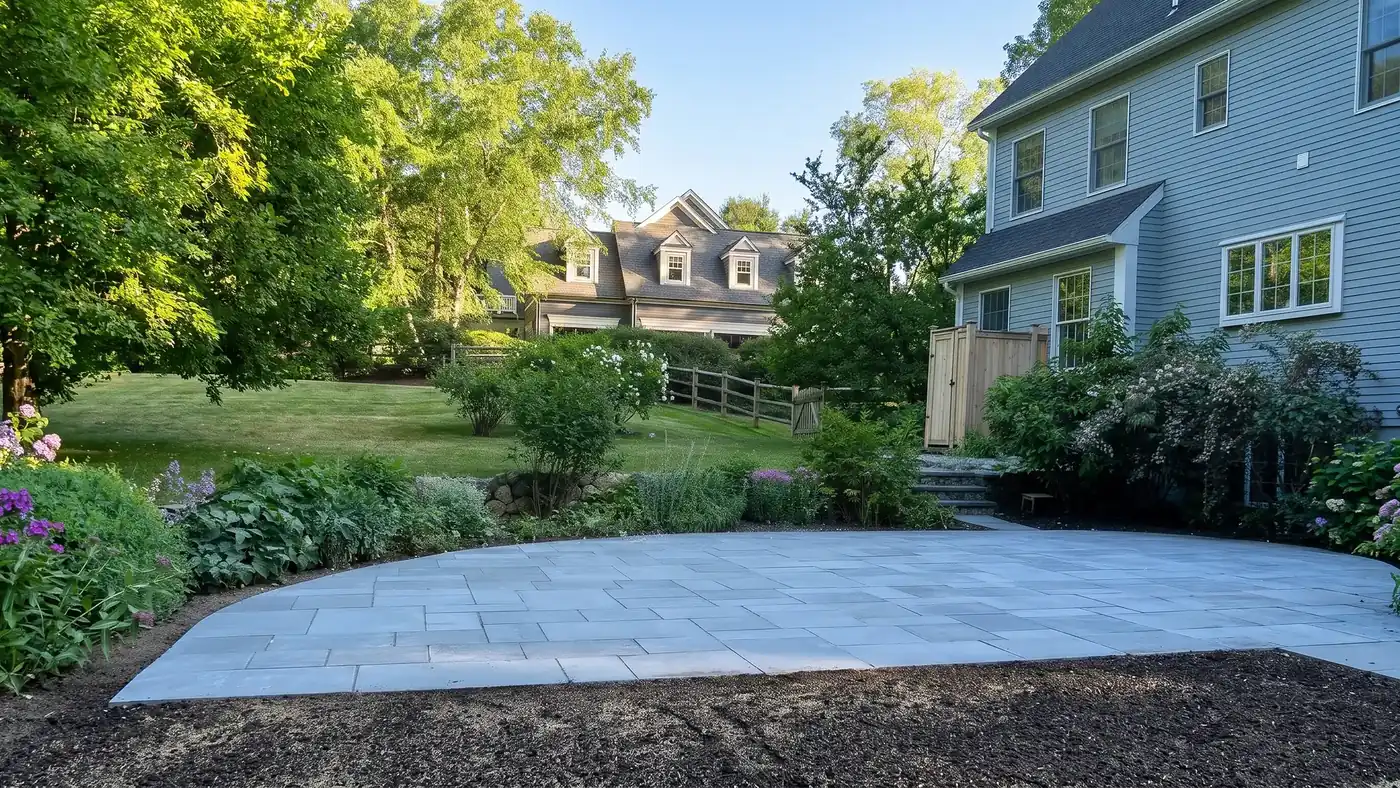
If you are planning a backyard patio in New England, the decision usually comes down to two materials: concrete pavers or natural bluestone. Both can look great and both can last a long time, but they cost different amounts, feel different underfoot and age differently through our winters. Understanding paver patio cost, and how bluestone compares, makes it much easier to choose.
This guide covers typical market price ranges for both, explains the difference between dry laid and mortared bluestone, and walks through the site factors that change any patio quote. It is written for homeowners in Massachusetts, Rhode Island and New Hampshire, where freeze and thaw is the real test of a patio.
What does a paver patio typically cost?
Concrete paver patios are usually priced per square foot, installed. Typical market ranges in New England often fall around $15 to $35 per square foot, with premium paver lines, tumbled finishes and intricate patterns at the higher end or above it.
A common backyard patio of 300 to 400 square feet would therefore land somewhere in the mid four figures to the low five figures for the patio surface alone. Steps, seat walls, curves and lighting are extra. These are general ranges, not a quote, and the site is what really decides the number.
What does a bluestone patio typically cost?
Bluestone is a natural sandstone, much of it quarried in Pennsylvania and New York, and it has been a classic New England patio and walkway material for generations. It generally costs more than concrete pavers. Dry laid bluestone set on a compacted gravel and stone dust base often falls in a typical range of about $25 to $45 per square foot installed.
Mortared bluestone, where the stone is set in mortar on a concrete slab, usually costs more, often in the range of $35 to $60 or more per square foot, because you are building two systems: the slab and the stone on top. Irregular natural cleft pieces fit like a puzzle and take more time to lay than cut rectangular patterns.
Bluestone vs pavers: how do they really compare?
Look. Bluestone has natural color variation in blues, grays and sometimes lilac or rust tones, and it suits older colonial and cape style homes. Pavers come in many colors and shapes, are perfectly uniform, and can be made to look like stone, brick or modern slabs.
Feel and comfort. Bluestone is smooth and solid underfoot. It can get hot in direct afternoon sun, especially darker pieces, so it is worth thinking about where the sun hits. A thermal finish (a flame textured surface) gives better grip than smooth natural cleft when wet.
Maintenance and repair. Both are repairable when dry laid: individual units can be lifted and reset. Pavers are easy to match later because they are manufactured. Matching natural bluestone years later is possible but the color will vary. Mortared bluestone is the cleanest look, but if the slab cracks, the repair is bigger.
Which surface handles freeze and thaw better?
Both materials handle New England winters well when the base is built correctly. The real enemy is water trapped under the patio. A dry laid patio, paver or bluestone, sits on a compacted base of crushed stone, commonly about 4 to 8 inches for a patio depending on the soil, and it is pitched slightly away from the house so water runs off. The joints let the surface move a little with frost without cracking.
Mortared bluestone on concrete is rigid. It needs a properly built slab and good drainage, or the mortar joints can crack over time. Concrete pavers can be sensitive to some deicing salts, so check which products are safe if you plan to treat the patio in winter.
What factors change your patio quote?
Excavation and grade come first. A flat, open yard is the cheapest case. A sloped yard may need a retaining wall or steps to create a level patio, which can add a lot. Rocky soil and ledge, common in Worcester County and parts of MetroWest, take more time to dig.
Access matters: if a skid steer cannot reach the backyard, base material and stone have to be moved by hand or with small equipment. Removing an old patio or deck footings adds labor and disposal. Design details such as curves, borders, inlays, built in steps and seat walls all add cutting and time.
Drainage is the last big item. If water already pools where the patio will go, the plan may need a drain or a dry well to keep the base dry.
How do you choose between bluestone and pavers?
Choose bluestone if you want a natural, timeless look that matches an older New England home, and the budget allows for it. Many homeowners love the way a large bluestone patio sits in a backyard, and bluestone steps with a fieldstone face are a classic pairing.
Choose pavers if you want the most design options for the money, an easy way to match units for future repairs, or a specific color and pattern. Pavers also work well under a deck or around a fire pit where you want a durable, uniform surface. Combining them is common too: a paver field with a bluestone border, or bluestone steps leading down to a paver patio.
How do you get an accurate patio estimate?
Mark the shape and size you want with a hose or spray paint, and take a few photos of the area and how water drains after rain. Decide which surfaces you would consider, and ask each contractor to quote the same scope, including base depth and drainage.
Machado Landscaping & Construction builds bluestone and paver patios, steps and walkways for homeowners and builders around Marlborough, Sudbury and across Massachusetts, Rhode Island and New Hampshire. We give free estimates with no visit fee and keep the job site clean and organized. Call (508) 663-9401 and we will reply within 1 hour during business hours, Monday to Saturday.
Frequently asked questions
- Is bluestone more expensive than pavers?
- Usually yes. Typical market ranges put dry laid bluestone around $25 to $45 per square foot installed and concrete pavers around $15 to $35, with mortared bluestone higher still. Site conditions can shift both.
- How much does a 400 square foot paver patio cost?
- At typical market ranges of about $15 to $35 per square foot, a 400 square foot paver patio often falls between roughly $6,000 and $14,000 for the surface, before steps, walls or drainage. A site visit is needed for a real number.
- Is bluestone slippery when wet?
- Smooth natural cleft bluestone can be slicker when wet than textured pavers. A thermal finish gives better grip, which is why it is a popular choice around pools and steps.
- Should a patio be dry laid or mortared?
- Dry laid patios on a well built gravel base are flexible, drain through the joints and are easy to repair. Mortared bluestone on concrete gives a very clean, formal look but is rigid and costs more. Both can work well when built correctly.
- Do you charge for a patio estimate?
- No. Machado Landscaping gives free estimates with no visit fee. Call (508) 663-9401.
Related services
Serving
Found this helpful? Make us a preferred source on Google.
Ready for an exact price?
Get a free, no-pressure in-home estimate. Real numbers for your home, not a phone guess.