
French Drain vs Dry Well: Cost and Which Solves Your Yard Drainage
· By Sidney Mota Machado
Water that sits on the lawn for days after a storm, a muddy strip along the side of the house, a downspout that floods the same corner every spring: these are the problems that send homeowners searching for yard drainage solutions. Two names come up again and again, the French drain and the dry well. They are often mentioned as if they were alternatives, but they do different jobs, and many properties need both working as a system.
This guide explains how each one works, what French drain cost and dry well cost typically look like, and how to decide which one your yard actually needs. The heavy, clay rich soils and ledge found in parts of Massachusetts, Rhode Island and New Hampshire make that decision more important, because water that cannot soak in has to be sent somewhere.
What a French drain does
A French drain is a trench filled with washed stone and a perforated pipe, usually wrapped in filter fabric so soil does not clog it. Water in the surrounding ground flows into the stone, enters the pipe and runs downhill to an outlet. In other words, a French drain collects and moves water. It is the right tool for a wet strip of lawn, a slope that keeps the soil saturated, or groundwater building up along a foundation.
The key requirement is somewhere for the water to go. The pipe needs a steady slope toward a lower outlet, which can be a spot where the pipe daylights on a downhill part of the property, a storm drain where allowed, or a dry well.
What a dry well does
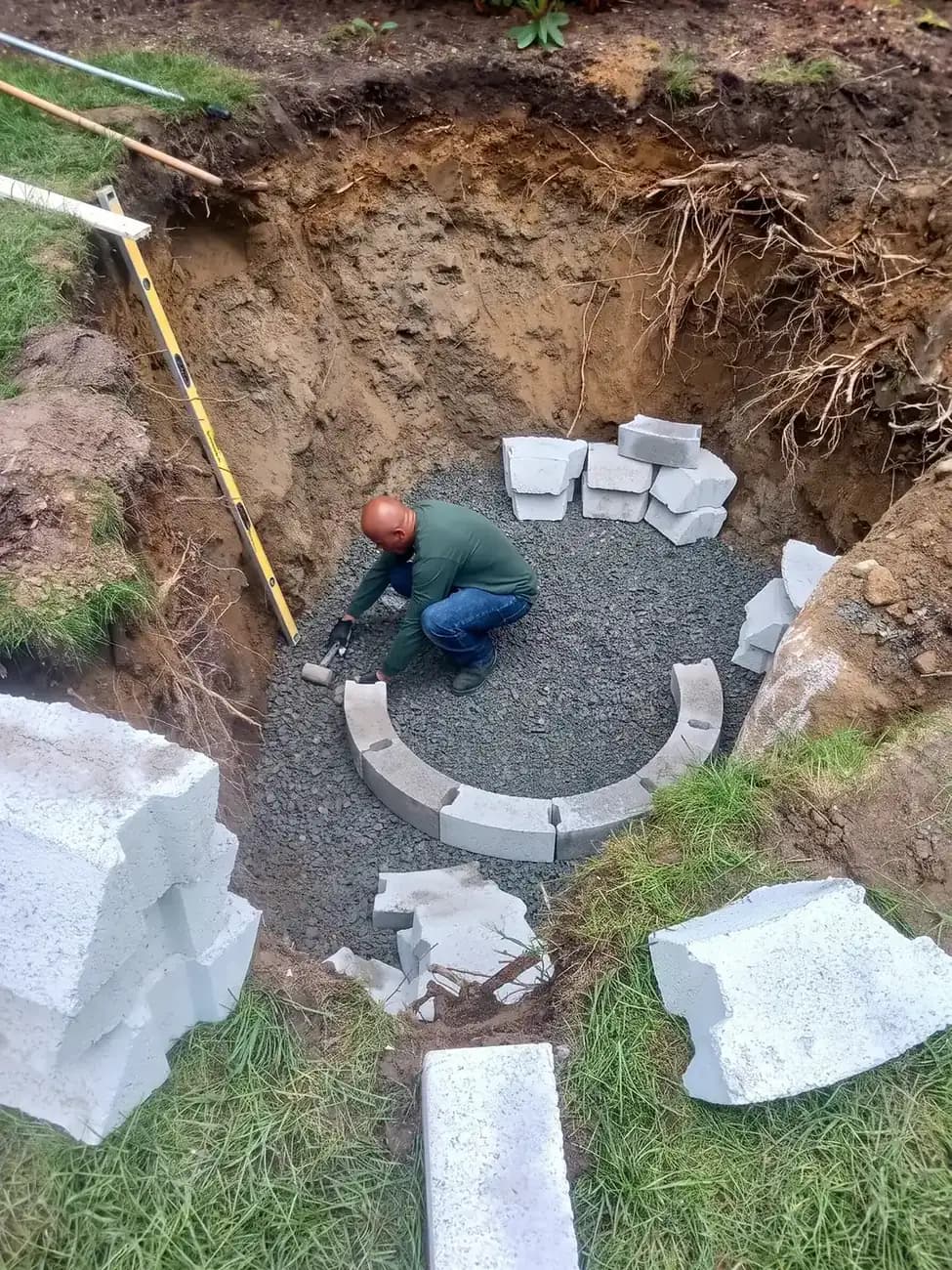
A dry well is an underground chamber that receives water and lets it soak slowly into the surrounding soil. A typical installation starts with excavating a pit, laying a base of crushed stone, then stacking precast concrete block rings (or setting a plastic chamber) to form the well, surrounding it with more stone, and topping it with a concrete or heavy duty cover before the pipe from the downspout or drain is connected and the area is backfilled and regraded.
Where a French drain moves water, a dry well stores it and spreads it out underground. It is ideal for roof runoff from downspouts and for flat lots where a French drain has no low point to drain to. The catch is soil: a dry well depends on the ground around it absorbing water, so very dense clay or shallow ledge can limit how well it works.
Typical French drain cost
French drains are usually priced by the linear foot. As a rough market range, many installations fall around $15 to $50 or more per linear foot, which often puts a typical residential job somewhere between $2,000 and $7,000. Longer runs, deep trenches along a foundation, rocky soil and restoring lawn, patios or plantings afterward push the number higher.
Shallow surface drains that catch runoff in a lawn are at the lower end. Deeper curtain drains that intercept groundwater on a hillside, or footing drains next to a foundation, cost more because of the excavation depth and the amount of stone involved.
Typical dry well cost
A single dry well for one or two downspouts often runs somewhere around $1,500 to $5,000, depending on its size, the depth of the excavation, how far the pipe has to travel and whether the work needs a machine or has to be dug by hand in a tight spot. Larger systems with multiple wells, or wells that receive water from a long French drain, cost more.
Soil testing matters here. If water does not drain well into the native soil, the well needs to be bigger or paired with another solution, so a contractor should look at the site and the soil before recommending a size.
French drain vs dry well: which one do you need?
Ask two questions. First, where is the water coming from? Concentrated roof water from downspouts points to a dry well, because it arrives in a burst at one spot. Water spread across a wide area of lawn or seeping out of a slope points to a French drain, because it needs to be collected along a line.
Second, where can the water go? If the property slopes and there is a safe low point well away from the house and neighbors, a French drain that daylights is often the simplest answer. If the lot is flat or every low point is a problem, the water has to be stored underground, and a dry well becomes the destination. That is why so many systems combine both: a French drain collects the water and a dry well at the end receives it.
Common mistakes that make drainage fail
The most common failure is skipping filter fabric or using the wrong stone, which lets fine soil migrate into the pipe and slowly clogs it. Another is running a pipe without enough slope, so water sits in low spots instead of moving. With dry wells, the usual mistake is sizing the well for a guess instead of the roof area and soil it actually serves.
Water also needs to be sent somewhere it will not cause a new problem. Discharging onto a neighbor's property or right next to a driveway that freezes creates a different headache. Before any digging, call 811 so underground utilities are marked.
Get a drainage plan for your yard
Machado Landscaping installs French drains, dry wells and complete yard drainage systems, and we document the dry well process step by step, from excavation and stone base to block rings, cover and pipe connection. We keep job sites clean and organized and restore the area when the work is done. The estimate is free with no visit fee. Call (508) 663-9401 and we reply within 1 hour during business hours, Monday through Saturday.
Frequently asked questions
- How much does a French drain cost?
- As a rough market guide, French drains often cost about $15 to $50 or more per linear foot, which puts many residential jobs between $2,000 and $7,000. Trench depth, length, soil conditions and surface restoration all affect the final price.
- How much does a dry well cost?
- A single residential dry well for one or two downspouts often runs around $1,500 to $5,000, depending on size, excavation depth, pipe length and site access. Larger multi well systems cost more.
- What is the difference between a French drain and a dry well?
- A French drain collects water along a stone filled trench and carries it away through a perforated pipe. A dry well is an underground chamber that receives water and lets it soak into the soil. Many yards use a French drain that empties into a dry well.
- Can I connect my downspouts to a dry well?
- Yes, that is one of the most common uses of a dry well. A solid pipe carries roof water underground from the downspout to the well, which keeps the water away from the foundation and off the lawn.
- Does a dry well work in clay soil?
- It can, but dense clay absorbs water slowly, so the well usually needs to be larger or combined with other drainage. A site visit to check the soil is the best way to size it correctly.
Found this helpful? Make us a preferred source on Google.
Ready for an exact price?
Get a free, no-pressure in-home estimate. Real numbers for your home, not a phone guess.