
Fences and Yard Drainage in Nashua, NH: Planning for New Hampshire Winters
· By Sidney Mota Machado
Nashua sits where the Nashua River meets the Merrimack, and the city has everything from older neighborhoods near downtown and the North End to newer subdivisions toward the Hollis and Hudson lines. Whatever the age of the house, two backyard questions come up again and again: how to put up a fence that stays straight, and how to deal with water that sits in the yard every spring.
Those two questions are more connected than they seem. Wet soil and deep frost are what push fence posts out of line in southern New Hampshire. This guide covers fence planning, materials and local rules to check, plus the drainage fixes that are worth doing before or with the fence. Machado Landscaping & Construction Inc is based in Marlborough, MA and takes on fence and drainage projects in New Hampshire, including Nashua.
Why New Hampshire frost moves fence posts
In winter, the ground in southern New Hampshire freezes deep. Water in the soil turns to ice and expands, and that movement, called frost heave, can lift a fence post a little every year. Posts set too shallow, or set in soil that holds water, are the ones that lean, rise or pull the fence out of line.
The fix is in the installation. Posts should be set deep enough for local frost conditions, with a footing and backfill that drain well instead of trapping water around the post. Gravel at the base of each hole helps water move away. On wet sites, fixing the drainage first protects the fence for years.
Gates are the most sensitive part. A gate post carries extra load every time it swings, so it usually needs a deeper or stronger setting than the line posts.
Vinyl, wood or metal?
Vinyl is popular for privacy fences because it does not need painting or staining and it holds up to snow and moisture. Quality varies a lot between products, and cheap vinyl can get brittle in hard cold. A thicker profile with reinforced rails is worth asking about.
Wood, such as cedar or pressure treated pine, has a natural look and is easier to customize. It needs periodic staining or sealing to last, and boards near the ground take the most abuse from wet snow. Keeping the bottom of the boards slightly above grade helps.
Metal fences, like aluminum or steel ornamental styles, are common around pools and front yards where you want a boundary without blocking the view. Chain link remains a practical option for pets and budget projects. The best material depends on privacy needs, style and how much upkeep you are willing to do.
Height rules, property lines and neighbors
Nashua has its own rules for fences in residential zones, including height limits and special cases near major roads. Pools have separate barrier requirements. Rules can change, so check the current requirements with the City of Nashua before you finalize the design.
Know where your property line is. A recent survey or your plot plan is the best reference. Many homeowners set the fence slightly inside the line to avoid disputes. If you are in a neighborhood with an HOA, check its rules too, since some limit styles, colors or heights.
Talking to your neighbors before the fence goes up is always a good idea. It avoids surprises and, in many cases, they are happy to see a clean new fence replace an old one.
Solve the wet spots before the fence
Many Nashua yards have a low corner that stays wet after snowmelt and heavy rain. If the fence line runs right through that area, the posts will sit in saturated soil, which is exactly what drives frost heave and rot.
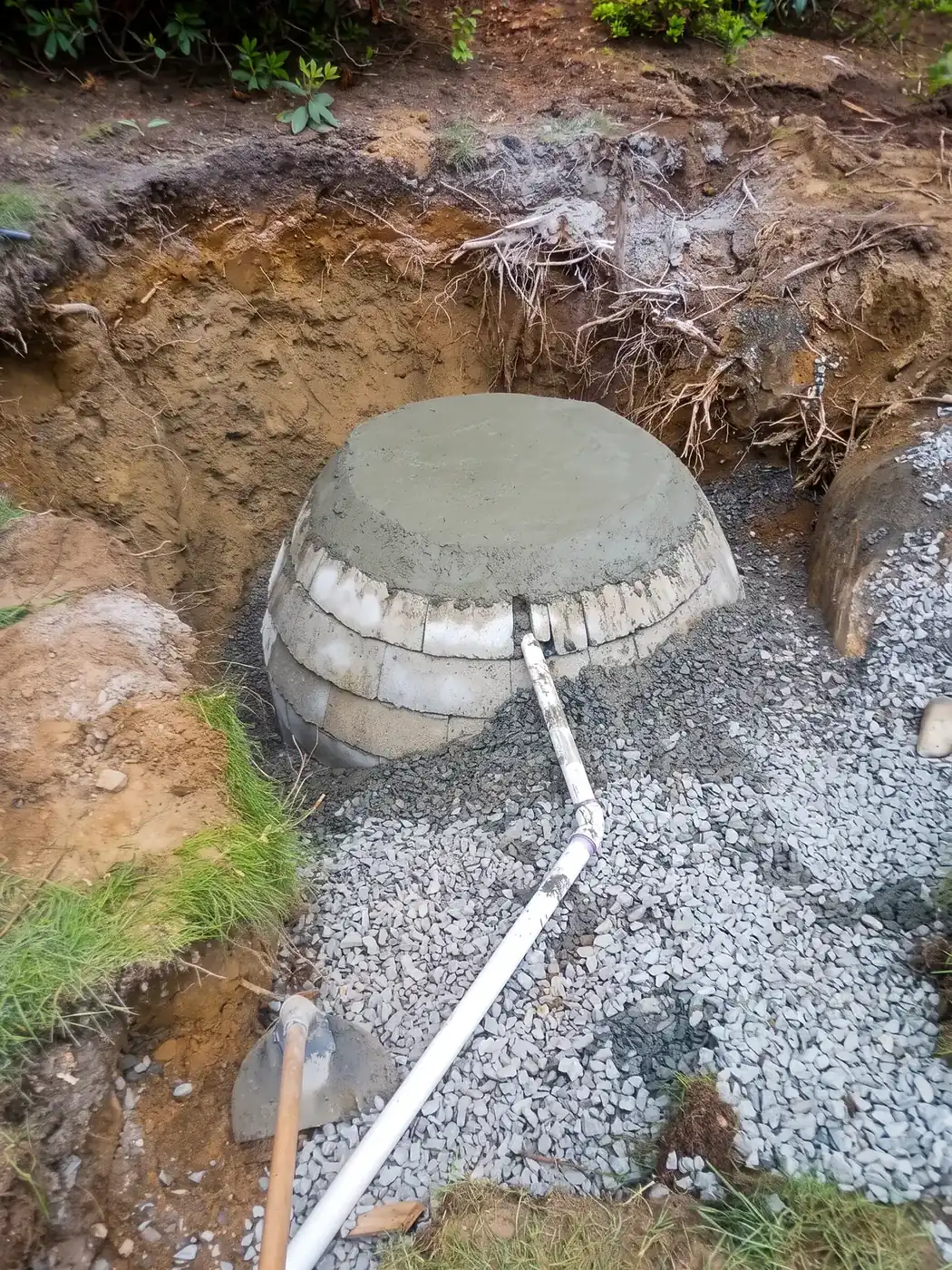
Common fixes include regrading so water flows away from the house, a french drain that catches water along the low side and carries it to a better spot, or a dry well that collects water from a downspout or a drain line and lets it soak into the ground below. The right choice depends on the slope, the soil and where the water is coming from.
Roof water is often the biggest source. Downspouts that dump next to the foundation can flood the basement and soak the side yard. Routing them underground to a dry well during a fence or landscaping project is efficient because the yard is already being worked on.
Timing: build before the ground freezes
Fence posts need to be set in unfrozen ground, so most fence work in New Hampshire is done from spring through late fall. Drainage work also has to happen while the ground is workable. Late summer and early fall are often a good window: the soil is dry and the fence is ready before the first snow.
Spring is the busiest time to book, as everyone wants privacy for summer. Getting an estimate in the off season gives you more choice of dates.
What a fence typically costs
Fence prices vary with material, height, length, the number of gates and how difficult the ground is to dig. Across New England, installed fences often range from roughly $20 to more than $60 per linear foot depending on the material and style, with chain link at the lower end and premium vinyl, cedar or ornamental metal higher. Rocky ground and ledge can add cost.
These are only typical market figures. Your estimate depends on your yard. Machado Landscaping gives free estimates with no visit fee and replies within 1 hour during business hours, Monday to Saturday.
Frequently asked questions
- Do I need a permit for a fence in Nashua, NH?
- It depends on the fence height, location and use, such as a pool barrier. Requirements can change, so confirm with the City of Nashua Department of Building Safety before installation.
- How deep should fence posts be in New Hampshire?
- Deep enough for local frost conditions and the fence height, with good drainage at the base. Shallow posts are the main reason fences lean after a few winters. Gate posts usually need extra depth.
- Which fence material lasts best in New Hampshire winters?
- Quality vinyl and aluminum need the least maintenance. Cedar lasts well when it is kept off the ground and sealed periodically. Installation and drainage matter more than material for how straight the fence stays.
- Should I fix drainage before installing a fence?
- If the fence line crosses a wet area, yes. Posts in saturated soil heave and rot faster. Doing the drainage first, or at the same time, is usually the most cost effective approach.
Related services
Serving
Found this helpful? Make us a preferred source on Google.
Ready for an exact price?
Get a free, no-pressure in-home estimate. Real numbers for your home, not a phone guess.